
Living Connections Short Answer
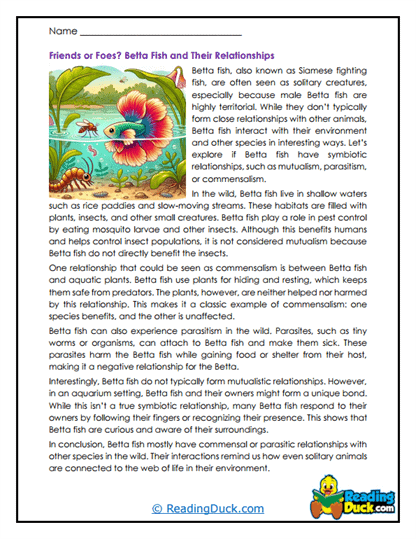
Betta fish are often described as solitary, but they are still connected to many other living things in their environment. This passage explores several kinds of relationships involving bettas, plants, insects, parasites, and even human caretakers. Students encounter examples of commensalism and parasitism while also considering how bettas benefit from vegetation, feed on mosquito larvae, and respond to people in aquarium environments. The reading reinforces the idea that even animals that spend much of their time alone are still part of a much larger ecological network.
This worksheet gives students valuable practice comparing different types of relationships and deciding how each organism is affected. Concepts such as parasitism, commensalism, host, ecosystem, and interaction become easier to grasp because they are tied to specific examples from the passage. Students also practice classification and higher-level reasoning as they determine whether an organism benefits, is harmed, or remains unaffected. It’s a strong conclusion to the collection because it encourages readers to connect the betta fish back to the larger web of life.