
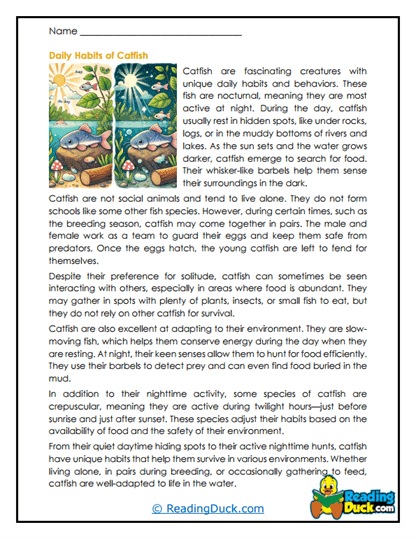
Night Routines
Catfish have daily habits that are especially well suited to life in dark, muddy water. This passage explains that many species are nocturnal, spending much of the day resting under rocks, logs, or along the bottom before becoming more active at night. Readers learn how catfish use their barbels and other senses to search for food when visibility is poor, and how some species may gather together during breeding seasons or when food is plentiful. The passage also introduces the idea that catfish behavior can shift depending on the species and the conditions of the environment.
Reading about daily behavior helps students practice sequencing, identifying patterns, and comparing activity at different times of day. Vocabulary such as nocturnal, solitary, breeding season, and adaptation develops naturally through the text. Students also strengthen comprehension by connecting behavior with the environmental challenges catfish face. This kind of passage is useful for showing how routines and survival strategies often go hand in hand.
Questions:
Answer Keys: