Pond Helpers Multiple Choices
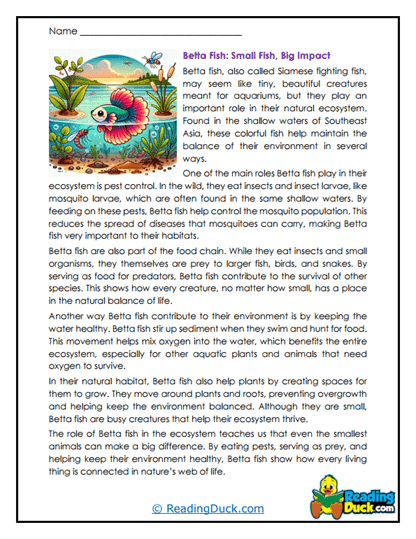
Betta fish may be small, but this passage shows students that even tiny animals can make meaningful contributions to an ecosystem. Readers learn how bettas feed on insects and mosquito larvae, helping regulate those populations, while also serving as food for larger fish, birds, and other predators. The reading explains how their movement through shallow water can stir sediment and influence oxygen levels, and how their interactions with plants and smaller organisms connect them to the larger food web. Students begin to see that ecological importance isn’t determined by an animal’s size.
This worksheet helps children move from thinking about a single species to understanding a whole system of relationships. Students practice tracing food-chain connections, identifying cause-and-effect relationships, and explaining how one animal can influence several others. Vocabulary such as ecosystem, predator, prey, population, and food web becomes easier to understand because each term is tied to a concrete example. It’s a strong passage for developing systems thinking alongside reading comprehension.