
Wild Voices
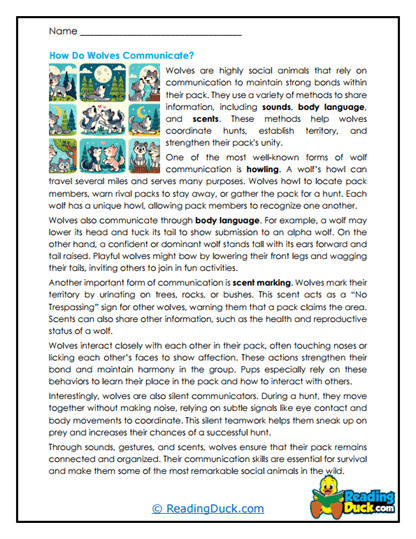
This passage explores the many ways wolves communicate through sounds, body language, and scent marking. Students learn how howls serve as long-distance calls, how posture and tail movement express emotion, and how scent marking defines territory. The passage also describes affectionate behaviors like nuzzling and licking, which help strengthen social bonds.
This passage enhances interpretive reading and context-based vocabulary by exploring communication behaviors. Students practice identifying multiple communication modes, strengthening categorization skills. It also promotes critical thinking about nonverbal cues, enriching both scientific literacy and language comprehension.
Questions:
Answer Keys: